
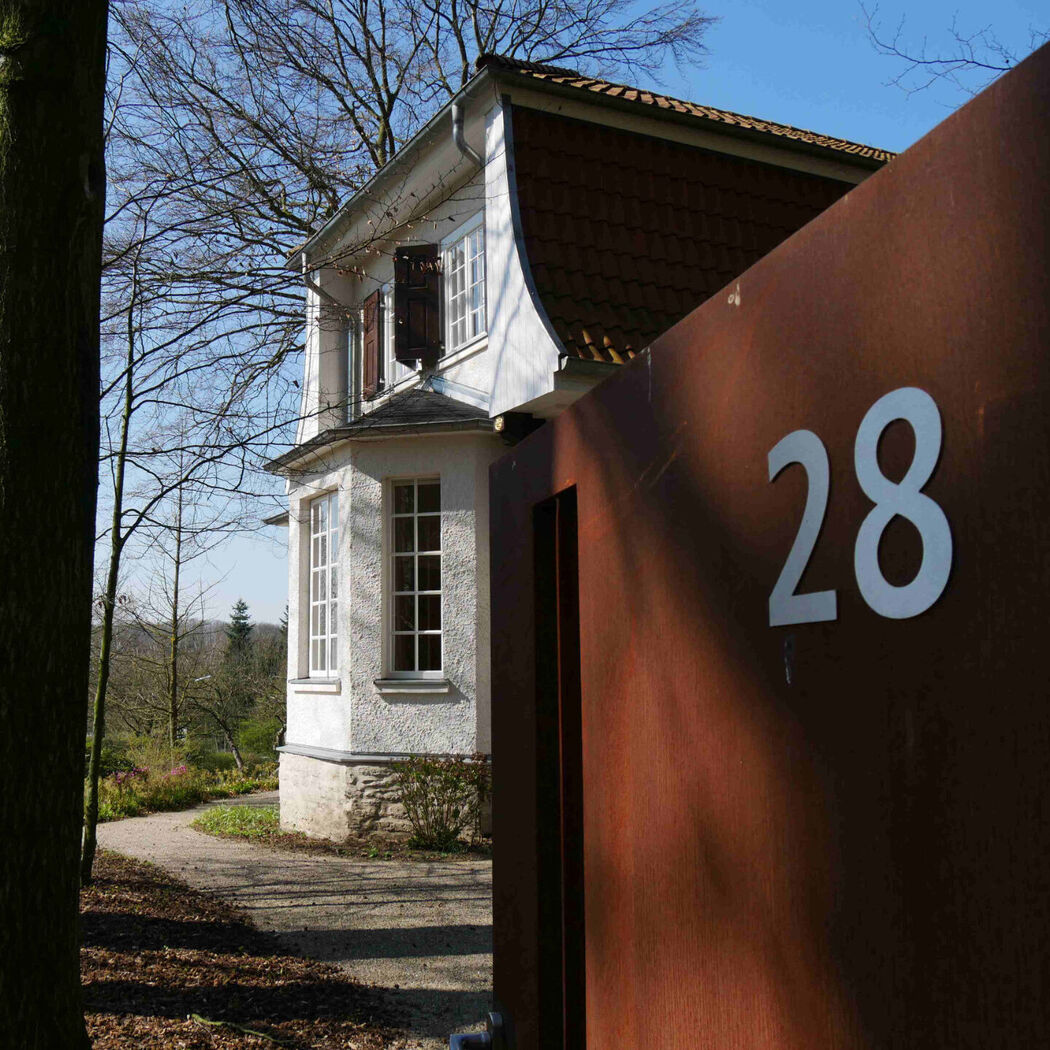
After more than a year of construction, the new headquarters of the Friedel & Gisela Bohnenkamp-Stiftung was completed in September 2014. The founder, Gisela Bohnenkamp, expressed her delight at the opening: “I am pleased that the foundation will be able to work in a unique atmosphere and setting in the future.” This distinctive setting is the Schölerberg, particularly the nearby Osnabrück Zoo. As a neighborly gesture, the zoo’s Zoo School contributed a donation of €10,000 to the foundation upon its move. Working closely with the monument protection authorities of the Osnabrück, the building underwent extensive renovation and modernization. The aim was to improve energy efficiency while removing many later structural additions and restoring the building’s original character. The simplicity of the former private rooms of the painter Franz Hecker (1870–1944) on the upper floor is echoed in the new interior design. Today, this level houses staff offices and a kitchenette. On the ground floor, the painter’s studio has been restored to its original dimensions. This floor also includes a conference room, a fireside lounge, and a conservatory adjoining the entrance area. The basement accommodates the IT infrastructure and building services. Franz Hecker originally built the house for himself in 1912–1913, using relatively simple materials.
The architecture of the house reflects the historicist style of the early 20th century, incorporating Baroque-inspired elements and designed according to the ideas of the painter Franz Hecker. He demonstrated notable boldness in his use of strong colors. The building was officially listed as a historic monument on July 1, 1983. The architects Christian Heißenberg and Matthias Sycha from Bad Salzuflen carefully investigated the structure to uncover traces of its original materials and color schemes. To support this work, restorer Susanne Schmidt from Friedland, Lower Saxony, Germany carried out a detailed restoration analysis. Based on these findings, the once vibrant color scheme of the ground-floor rooms was reconstructed. In addition, the plaster surfaces of the façades and decorative elements on windows, doors, and wooden structures were restored and made visible once again. The redesign of the garden aimed to highlight and preserve its historical character. Existing architectural features—including the garden house, well house, steps, and pathways—were carefully conserved or renewed. Mature trees and established hedges now form the structural framework for a flourishing garden that combines fruit trees with ornamental plantings.


